Speakers
Fred Baker Cisco Systems
Data Center Latency Control
Cisco Fellow Fred Baker will discuss the Data Center Latency Control problem, and the nascent IRTF research group working on it. The problem is related to that of TCP Congestion Control, the exception that while Congestion Control tries to maximize throughput at all costs, latency control tries to maximize throughput while minimizing latency. Part of the issue has been incast in Map/Reduce applications in data centers; that itself may be giving way to superior data center models.
Biography
Cisco Fellow Fred Baker has been involved in data communications since 1978 and the development of the Internet since the 1980’s. He has been involved in standards development in the IETF, both contributing technically and managing processes. His current interests are in routing, the management of latency and data flow, and the universal deployment of IPv6, and the public policy implications they bring with them.
Roland Dobbins Arbor Networks
When the Sky is Falling: Network-Scale Mitigation of High-Volume Reflection/Amplification DDoS Attacks
This session will focus on network-scale best practices for detection, classification, traceback and mitigation of high-impact, high-volume reflection/amplification DDoS attacks ranging from the tens of megabits/sec up to more than 300gb/sec in size. Principles and properties of reflection/amplification attacks will be discussed, including specifics of common reflection/amplification methodologies. Incident management practices for handling large-scale network-impacting attacks will also be covered.
All AusNOG talks (7)
- AusNOG 2015 Your Bitcoins or Your Site: An Analysis of the DDoS for Bitcoins (DD4BC) DDoS Extortion Campaign (Arbor Networks) Slides
- AusNOG 2014 When the Sky is Falling: Network-Scale Mitigation of High-Volume Reflection/Amplification DDoS Attacks (Arbor Networks)This year
- AusNOG 2013 Breaking the Bank: An Analysis of the 2012 - 2013 'Triple Crown' Financial Industry DDoS attacks. (Arbor) Slides
- AusNOG 2012 In the Air Tonight: Operational Security Challenges for Wireless Internet Access Providers (Arbor) Slides
- AusNOG-05 (2011) State of Danger: Eliminating Excessive State in Network, Application, & Service Architectures as a DDoS Defense Strategy. (Arbor) Slides
- AusNOG-04 (2010) Obviating the Tragedy of the Commoms: Operational Security Implications of a National Broadband Network (Arbor Networks)
- AusNOG-03 (2009) The Emperor's New Cloud: An Analysis of the RoK/USA DDoS Attacks. (Arbor Networks) Slides
Biography
Roland Dobbins has 30 years of operational experience in the serviceprovider (SP) and large enterprise arenas, designing, deploying,operating, securing, maintaining, troubleshooting, and defending many ofthe highest-visibility networks in the world. He is a recognized industryleader in the fields of operational security (opsec) and networktelemetry, and has an extensive background in security product/featureinnovation, devising operational security requirements for networkinfrastructure devices, and protocol design.
His focus is on extending the availability, scalability, and security ofthe network infrastructure and the applications/services it enables, withan emphasis on flexible and resilient global service deliverycapabilities.
James Dollar Uplogix Inc.
Presentation title: Escaping the network management dark ages
Today’s networks generally look very different to those of 10 years ago: Multi vendor, multi-service networks often with a vast geographical reach. Traditional network & device management techniques have evolved more slowly than the platforms they manage and are often the source of service outages and operations headaches. This presentation will focus on the evolution of network management techniques and technologies and describe a set of best practices that can apply to both new and existing networks.
Biography
Mr. Dollar is a respected technology innovator with 20 years experience designing and managing network communication infrastructures. Before founding Uplogix he was a key network architect at several application service providers, responsible for 99.999% application and network availability. Mr. Dollar has spent over a decade with world-class organizations such as The Coca-Cola Company and Reliant Energy, driving key aspects of technology and network architecture strategies.
Simon Hackett Non-Executive Director of NBN Co Limited
Rebooting The NBN - Reflections On The Journey Thus Far
The author (having been a long term public constructive critic of Australian National Broadband Network policy) accepted an invitation to join the board of NBN Co in late 2013 as part of its post-election reboot.
He will reflect upon various aspects of the NBN including: Progress of the reboot to date, the view from inside the tent, and why being on the board of NBN Co doesn’t (necessarily) prove that he has Abandoned The One True Way and Turned To The Dark Side.
Biography
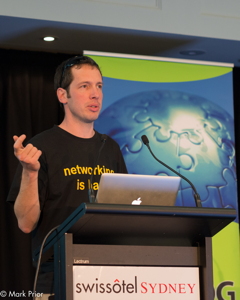
Simon was involved in building AARNet Version 1 and he has been using - and installing - Internet links since well before the Internet was trendy.
Beatty Lane-Davis Cyan Inc.
Future metro architectures
What are the factors that are going to define the shape of the metro networks of the future? Silicon density, physical plant, power, regulatory shenanigans, practical realities of protocol architecture, coherent detection, moon phases and astrological signs? This talk is going to explore the interplay between the variables involved and come to very few conclusions, perhaps even more questions than answers if we’re lucky. It will draw on data points from the worlds of: silicon development, standardization, recent examples from countries with outstanding regulatory shenanigans, software-defined whatever and the thinking of forward-looking tier-1’s from around the globe.
All AusNOG talks (4)
- AusNOG 2018 Subsea for non-physicists
- AusNOG 2016 Multi-layer path computation (Infinera) Slides
- AusNOG 2014 Future metro architectures (Cyan Inc.)This year
- AusNOG 2013 Software Defined Networks in Carrier Networks (Cyan Networks)
Diogo Montagner Juniper Networks
BGP-TE/LS - Application-Level Topology Intelligence
One of the challenges when deploying traffic engineering in networks is the lack of end-to-end visibility. Network planning, fault isolation, inter-area and inter-domain TE, smart routing and network knowledge at the application level are just few examples where the end-to-end visibility of the network is required. IETF has defined two applications where this visibility is required: ALTO (Application Layer Traffic Optimization) server [RFC5693] and PCE (Path Computation Elements) [RFC4655]. Both PCE and ALTO Server need to collect the information about the network in order to fullfill their function. The BGP-TE/LS is the mechanism used to collect Link State and Traffic Engineering (TE) information from the networks and share with external components using the BGP protocol. This presentation will focus on what BGP-TE/LS is, use case scenarios and, if the time allows, a live demo or a recorded demo.
All AusNOG talks (2)
- AusNOG 2018 Architecting Network Telemetry (Juniper Networks) Slides
- AusNOG 2014 BGP-TE/LS - Application-Level Topology Intelligence (Juniper Networks)This year
Biography
Diogo has worked in the networking industry for 18+ years. He is a passionate fullstack network engineer and occasional technical author and book reviewer. Diogo currently works as automation and software expert for Juniper Networks in APAC where he helps customers to design and deploy automation and software solutions.
Mark Smith
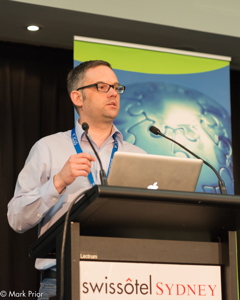
Network Virtualisation: The Killer App for IPv6?
A variety of network virtualization over layer 3 methods are currently being developed and deployed, such as VXLAN, NVGRE or STT. Each of these methods treats both IPv4 and IPv6 as equivalents, with both providing unicast and multicast capabilities.
IPv6 provides a number of capabilities not available in IPv4. In this presentation I will present a variety of ways that IPv6’s unique capabilities could possibly be leveraged to enhance the operation of any of these network virtualisation technologies. This will also demonstrate the benefits of IPv6 being more than just “IPv4 with bigger addresses”.
The desire to virtualise networks is being created by the desire to be able to move virtualised hosts outside of the physical server. One of the capabilities that virtualising the network over IPv4 or IPv6 provides is the ability to create a virtual network that spans multiple data centers, with the benefit of not only being a larger pool of physical server resources, but also better geographical redundancy for the services the virtualised hosts provide.
Following on from how IPv6 can enhance network virtualisation, we will take a higher level services view of what network and host virtualisation is providing, and how IPv6 may provide further benefits.
All AusNOG talks (7)
- AusNOG 2019 Getting IPv6 Private Addressing Right Slides
- AusNOG 2018 The Robots are Coming! Slides
- AusNOG 2016 The Trouble with NAT Slides
- AusNOG 2015 Why you should read RFCs and Internet Drafts (and what you need to know to do so) Slides
- AusNOG 2014 Network Virtualisation: The Killer App for IPv6?This year
- AusNOG 2013 The Rapid Rise of the Mobile Multihomed Host, and What It Might Mean to the Network Slides
- AusNOG-05 (2011) Residential IPv6 CPE - What Not To Do and Other Observations Slides
Biography
Mark began working in the ICT industry in the early 1990s, initially working with desktop PCs and servers. He made networking his professional focus in 1998.
Mark has held a number of roles, performing support, administration, deployment, design and presenting training. He has worked for state government departments, national and multinational system integrators and state, national and international residential and corporate ISPs and telcos.
Mark has also presented at the AusNOG conference 5 times, has written blog articles for APNIC by invitation, and has contributed to the IETF since 2002, primarily in the IPv6 6man and v6ops working groups. He is an acknowledged reviewer and contributor to 31 IETF RFCs, and the author of 9 IPv6 related Internet Drafts.
Elly Tawhai APNIC
APNIC Update
This short presentation is designed to update the Australian network operations industry covering what is happening around the world with Internet resources. Included are current statistics on AS numbers, IPv4, and IPv6 address delegations, updates on Internet resource policies (such as implementation of recovered IPv4 address blocks), IPv4 markets and transfers, interface service improvement along with other recent APNIC news, and affects on the local industry.
All AusNOG talks (7)
- AusNOG 2017 APNIC Update (APNIC) Slides
- AusNOG 2016 APNIC Update: IPv4 waiting list (APNIC) Slides
- AusNOG 2015 APNIC Update (APNIC) Slides
- AusNOG 2014 APNIC Update (APNIC)This year
- AusNOG 2012 APNIC Update (APNIC) Slides
- AusNOG-03 (2009) Whats happening within APNIC, APNIC update (APNIC) Slides
- AusNOG-01 (2007) APNIC Update (APNIC)

Usen Tulemisov Cisco Systems
Bandwidth-On-Demand capability in Carrier Network
With the rapidly growing Cloud Services market there is an opportunity to apply Cloud Consumption model to business telecommunications services. One approach Carriers could take is to develop Bandwidth-on-Demand capability to enable their customers to dynamically scale up or down their service and substantially decrease lead times and operations cycles associated with service activation. Whilst it is a complex topic the session gives an overview and number of pointers on some models, tools and approaches which are available now to support this overall goal.
All AusNOG talks (2)
- AusNOG 2016 Data analytics approaches to assist Network & Security Operations (Cisco Systems) Slides
- AusNOG 2014 Bandwidth-On-Demand capability in Carrier Network (Cisco Systems)This year
Biography
Usen is a Senior Systems Engineer in the Service Provider team at Cisco Australia. Usen holds a PhD in Information Systems, an MBA in General Management and has over a decade of experience working in IT and Telecommunications, assisting organisations develop and implement technology strategy in Internet, Cloud, Media and Utilities service provider markets.
Chris Wiren Defence Science and Technology (DSTO) Communication Networks Research (CNR) Group
An Analysis of the 2013 Icelandic Prefix Hijack
Internet routing is currently based upon a trust relationship that is open to abuse. In May 2013, an Icelandic ISP abused that trust relationship to advertise Australian IP addresses in a prefix hijacking attack. Using publically available BGP data we were able to confirm that 27 Australian IP prefixes were affected and the attack propagation was widespread. This talk will cover an analysis of the event, exploring how far the attack propagated and the effect this had on hijacking and rerouting Australian traffic. We look at the complex nature of the global Internet routing system and the models used to describe it. While the Internet is certainly complex, it is possible to derive meaningful results with only partial knowledge of the policies that underpin global routing decisions. This talk will conclude with a discussion on attribution, detection, prevention and future work.
Biography
Chris Wiren is a senior research engineer who has over 20 years’ experience in the telecommunications field. He is a self-confessed telecommunications geek with a particular passion for the alphabet soup of network routing protocols. During his time at DSTO he has presented at both international and national conferences, conducted training workshops and is currently promoting an awareness of routing protocol vulnerabilities. His research interests include Inter-Domain Routing, Interior Gateway Routing, Next Generation Networks and Network Emulation.
Jeff Young Juniper Networks
Packet Optical Convergence
Convergence of packet and optical networks has been talked about for a number of years, but with the deployment of 100G Coherent technology, we are seeing the first significant progress. This session will cover;
- A view of what is required for packet optical convergence
- Some results from field trials of integrated 100G Coherent solutions
- An insight into some of the early benefits and use cases for this technology, such as pre-emptive restoration
Biography
Mr. Young has worked in the Information Technology and Telecommunications industries for 25+ years. His experience spans both the end-user/enterprise, the service provider industry, the equipment vendor, and he has worked as an industry analyst. Mr. Young currently works for Juniper as the Director of Core Architecture in APAC where he helps enterprise and service provider customers develop and propose scalable and cost-effective network designs.